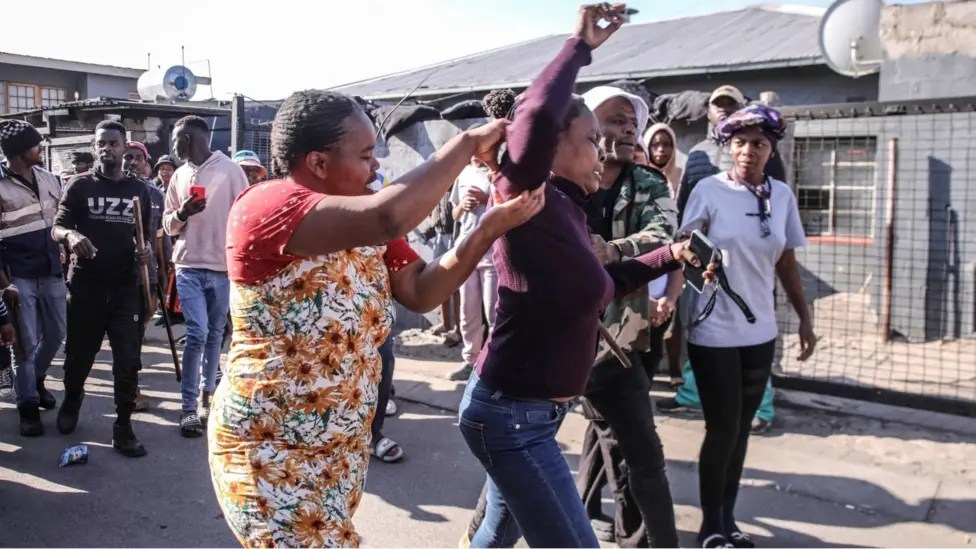
March and March’s concerns about the South African government’s ineffective immigration management are legitimate and need to be taken serious by the authorities; it is also true that many of the immigrants are from Zimbabwe and Malawi, but it is equally true that immigrants, regardless of legal status, have human rights that must be protected. There are legal avenues the March and March movement can explore to push formal institutions to act on immigration instead of turning itself into law; it is our view that vigilantism does not provide the answer to migration challenges.
Poor economic outcomes, decline in living standards for the average South African and the ever-widening socioeconomic inequalities are raising public anxiety, anger and resentment towards certain population groups. Unfounded allegations that the South African government only cares about immigrants abound leading to resentment of Zimbabwean migrants.
Because South Africans believe government institutions are ineffective, be it in managing migration or creating employment opportunities for locals thereby perpetrating harm rather than providing protections for citizens, public expectation is shifting away from state-sanctioned interventions to building people-driven interventionist groups.
Addressing the migration crises requires a multifaceted effort that will allow for the full participation of various regional, sub-regional and national institutions, source regions and the receiving territories; there is need to examine the broader internal and external socioeconomic and political structures that perpetuate specific migration trends.
What will it take for African regional, sub-regional and national bodies to protect their citizens from injustices and needless harm? Regional bodies need to be honest in addressing shared interests, including actions that expose citizens to undue harm – highlight and act on member states proven to be guilty of committing extrajudicial acts pushing citizens out of their borders and the equally hostile hosts.
Upset as certain groups in South Africa may be about immigrants, they need to understand that immigrants are entitled to protection against harm and discrimination. Fundamental human rights are universal, inherent entitlements; governments, institutions and individuals cannot choose to grant, withhold or ignore them. Africa already has the appropriate institutions operating at regional, sub-regional, and national levels to protect and promote fundamental freedoms.
Vigilantism deployed by the March and March movement in place of due process based on the factually devoid premise that immigration is the primary cause of South African problems and the emotive posturing that the public disagree with the principle of a law, e.g., the Zimbabwe Exemption Permit (ZEP) and Lesotho Exemption Permit (LEP) cannot be law; as an intervention, it is a faulty, emotive ‘solution’ informed by doctored ‘realities’ and does not even begin to address realities of marginalisation and inequality in South African society. Instead, it undermines societal trust, erodes the rule of law, and destroys public safety.
Some of March and March and its allies’ conduct seeks to restrict human rights by undermining human rights protections in law and practice. Disturbing videos of vigilante groups inciting violence against immigrants, stopping alleged undocumented foreigners from accessing public healthcare providers and children of immigrants being denied access to public schools are circulated on social media as are pictures of locals confronting suspected immigrants to prove their status in the country.
It is unsafe for everyone to allow policy discourse to be led by conspiratory organisations; if March and March and its allies believe the legal foundations of LEP and ZEP are flawed, they must exercise their constitutional right to present counter arguments against the legal premise of the existing law. Meanwhile, the movement must desist from enforcing immigration laws simply because it is dissatisfied with the efforts of the different law enforcement agents.
Those with huge reserves of hatred are barely able to reserve space for love for others or even the sense to try and understand the pain of others; instead, they find themselves immersed in the projection of their hatred. To seek to correct wrongs or perceived injustice by normalizing illegality, undermining laws, rationalising hatred sets a dangerous precedence.

First, it was about undocumented immigrants, and then it turned into ‘all Zimbabweans must go’. The March and March founder has previously argued that Zimbabweans’ immigration into South Africa is a psychological factor – the delusion that they were South Africans. This demonstrates ignorance of demographic characteristics of Zimbabwe and a fundamental misunderstanding of causes of migration in the sub-region; it lacks any sense of credibility to inform policy decisions about migration.
Nobody can know, with certainty, the true nature of their abilities, their own follies or perceive their sense of weakness until these have been reflected to them in the mirror of their patriotic constituents. South Africa cannot be expected to carry the burden of failing neighbours all alone; the continent must decentralise power and decision-making to promote economic growth, uphold human rights and protect citizens from state-sanctioned harm including unintended harm caused by state neglect of responsibilities.


Share your valued views.