
Black South Africans hunting down poor Black African immigrants but ignoring the structures that anchor inequalities in the country are laden with feelings and misused facts. The approach seems too lazy for an intervention to ‘fix’ complex post-apartheid South Africa’s problems. While unregulated immigration is a problem that requires remedying, it is a symptom than the foundation of the country’s problems.
Fixing South Africa’s problems requires level-headed people armed with data to properly diagnose the problem and work out corrective short-, medium- and long-term interventions not the vigilante groups who sell feelings, not facts, and also respond to an unregulated information environment.
Mass migration and the refugee crisis is one of the biggest problems facing the globalised world. In South Africa the public assumes that everyone is coming to South Africa; the reality is that it is an issue in Libya, Uganda, Türkiye and across Europe.
Globalization has brought significant economic benefits across the globe but so too have been challenges that governments face in a fast-paced world where movement of both humans and goods have become easier and increased in volume. The biggest problem remains the structural issues that enable unequal distribution of economic benefits across the globe leading to disproportionate migration of people to regions that offer better opportunities.
For several years now, South Africa has faced a growing flow of migrants from neighbouring African states and the African continent. While on one hand this has increased access to a larger pool of talent for the economy, on the other, it is exerting pressure on the country’s ability to provide necessities to the population and the perceived government failure to deal with undocumented migrants has raised public tensions.
People with vested interest in ‘fixing’ South Africa’s immigration problem must invest even more in understanding the causes; vigilantism as an intervention for illegal migration is like trying to find a needle in a haystack. This is a systemic and structural failure that requires patience and a collaborative approach between source regions and the receiving regions.
Mass deportation of migrants creates a spectacle, but it does not guarantee that migration will come down and that conditions will improve for locals; it has not saved the U.S.A. from an underperforming economy, it has not created more job opportunities for Americans, it will not create new opportunities for South African citizens. Just as is the case in the U.S., targeting foreigners in South Africa will lead to vigilantism, violence and inhumane treatment of the most vulnerable people.
South Africa’s problems which include economic stagnation, high levels of unemployment, poorly skilled workforce, inadequate welfare systems, unequal access to opportunities to economic benefits, corruption, concentration of power and wealth in the elite, and high levels of crime cannot be justifiably blamed on one population group – Black African migrants. Using the Black African migrant as a pawn on the chessboard of humanity in the South African socio-political landscape is scapegoating; migrants from African states are a soft target for the self-hating, often uninformed South African average Black population and the opportunistic political elite.
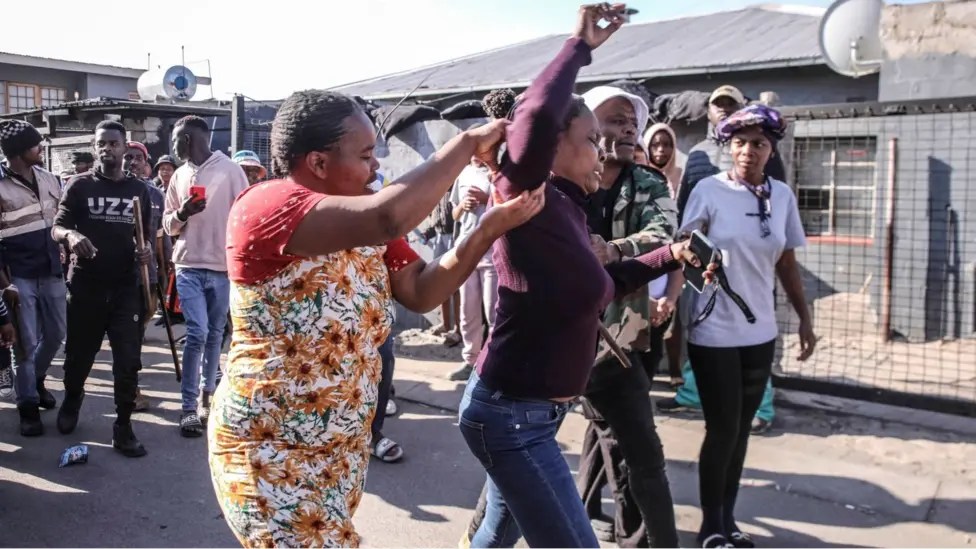
Opportunistic politicians are happy for the illegal and inhuman treatment of the Black African immigrant to persist because it is a distraction away from governance accountability questions.
Correctly diagnosing South Africa’s problems is essential for the identification of corrective policy decisions and actions. The inequality in the distribution of economic benefits is an issue acknowledged by many yet there is little real desire to address it decisively. It seems like there are deliberate attempts to de-emphasize the significance of structural causes to the country’s socioeconomic problems when a focus on structural accountability will be essential in understanding why the extant institutions designed to deal with migration and security are perpetually ineffective.
Inequality in South Africa has all markers of the legacy of apartheid. The power structure is the problem, not the Black immigrant trying to survive. Vigilante groups need to also fix their eyes on the foundation of their attitudes and immigration patterns. For instance, why are Black South Africans not hunting down White migrants and why are Zimbabweans, Malawians and Mozambicans the largest immigrant group in South Africa?
The migration from these countries has deep roots in apartheid South Africa. During the apartheid era, the government exploited migrant labour from across the African continent for cheap labour and to deliberately suppress wages in gold mines and weaken unionization. These historical structures preside over a legacy that treats foreign nationals as a temporary, easily exploitable labour force rather than integrated members of society.
Fighting poor Black immigrants will not solve South Africa’s problems because these immigrants are mere victims of unchecked global systems and not the base of South Africa’s problems. The question should be: How can South Africa play its role in protecting the most vulnerable Africans seeking its protection within its borders while building an inclusive economy? Emotional responses to migration will not begin to address it; chasing a poor Black African migrant down the narrow lanes in the townships will not stop the accumulation of wealth and power by the rich and political elite in the secure suburbs.


Share your valued views.