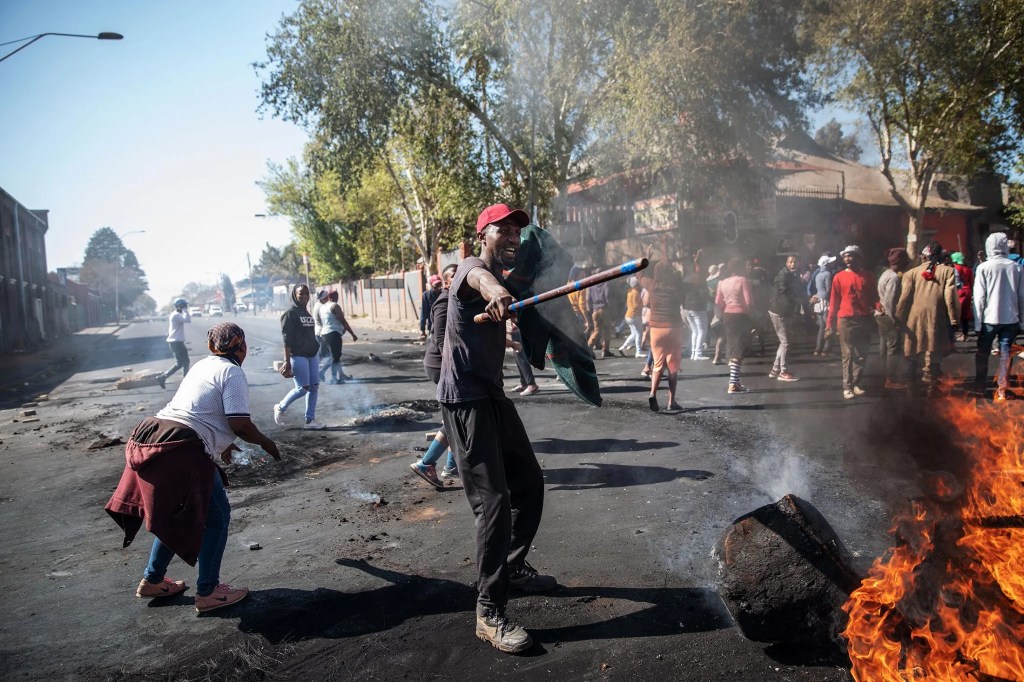
South Africans’ irrational fear of black immigrants and intentional hostility towards fellow black Africans risks the country descending into a rabbit hole of chaos and unstable socioeconomic space for years to come. Vigilante groups are targeting black immigrant communities to fish out illegal immigrants, but their ignorant activities are putting public security and the country’s investment at greater risk than the immigration they are fighting.
Hostile black people-led violent vigilante groups with neither the mandate nor skills of immigration management have made it their mission to hate and harass fellow black Africans. The Afrophobia and vigilantism has increasingly narrowed down to specific immigrant sources – Ghana, Nigeria, Mozambique, Zimbabwe, among others.
Opportunistic politicians, and civil organisations have joined vigilante groups in blaming foreign nationals for the country’s severe socioeconomic crises, including high unemployment, poverty, crime, and overwhelmed public services. However, what they never mention publicly is the failure of the SA economy to grow jobs and that has nothing to do migrants.
The self-appointed pseudo-immigration officials (Operation Dudula, ActionSA, March and March movements) claim to be against illegal immigration and undocumented immigrants, but their methodology of addressing the issue raises many ethical questions – Afrophobia and incitement to violence cannot be a legitimate platform; these are anti-migrant, violent vigilante groups with no expertise apart from irrational fear or hatred of black African foreigners. What is irrefutable is that hatred and cruelty for the sake of being hateful and cruel are the motives.
As black African immigrants, their homes and businesses are burnt down by black South Africans in an African state, accusations of xenophobia abound. These are difficult accusations to shake off. If the whole intervention was about illegal migration and undocumented migrants, due process – pathways are already available in South African statutes – would be their prioritised route and undocumented immigrants from all races not just blacks from certain countries in the continent would be the target.
Perhaps a brief explanation of what xenophobia is would help the conversation and inform migration policymakers.
Xenophobia – a word created in Europe in the late 19th Century and rooted from two Ancient Greek components: xénos, meaning “stranger,” “foreigner,” or “guest,” and phóbos, meaning “fear” or “flight” – is the fear or hatred of strangers or foreigners.
Xénos (ξένος): Implies an outsider. In ancient Greece, it heavily featured in social conventions and was largely tied to the concepts of hospitality and “guest-friendship”.
Phóbos (φόβος): Translates to an intense fear, panic, or the instinct to flee.
In its early appearances and original usage (c. 1880–1900) in English and French (as xénophobie), it was used by medical and psychology writers to describe an irrational, morbid dread of meeting strangers—functioning similarly to conditions like agoraphobia.
By the early 20th Century, the medical sense faded, and the word was adopted into political and sociological contexts to describe societal antipathy and prejudice toward foreigners and marginalised population groups.
Generations of Black people have fought a courageous and characteristically determined battle with oppressive regimes, a battle against self-hate must be won in this generation. Data sovereignty will be essential in building an informed constituency in South Africa. We need to understand why a critical issue like migration is being reduced to hatred.
To blame crime and lack of equal access to employment opportunities on immigrants is disingenuous and point-blank scapegoating. There is no objective evidence that immigrants block South Africans from employment opportunities. Many immigrants create employment opportunities for locals, contribute to government revenue through taxes; they are also themselves victims of exploitation by employers and corrupt law enforcement agents who take advantage of their vulnerability.
Immigrants do not make South Africa less safe, but xenophobia does. Think of South Africans killed after being mistaken for foreigners just because of their physical features. Immigrants do not take South African jobs, the jobs they do are rarely competitive high-end jobs; while there are highly skilled immigrants employed in high-end jobs, there is no evidence that equally qualified South Africans are systemically denied opportunities.
Many immigrants tend to fill roles in the low-end market – menial jobs, manual labour, etc., important roles that locals despise and do not want to do, some of these are the kind of jobs that free up skilled South Africans to go to work, e.g., baby-minding, caregiving for elderly parents, etc.
Challenges of uncontrolled immigration are well-documented and addressing migration is essential, but South African policymakers must not be cowed by the terror unleashed by the extremists drowning in the deep end of xenophobia; the Department of Home Affairs needs to maximise efforts to counter and stop xenophobia and stereotyping of foreigners.
While it is a fact that uncontrolled immigration raises many different challenges for South African society, self-appointed vigilante groups are not the solution and targeting certain nationalities and races for abuse is xenophobic and a dishonest, irrational approach to dealing with legitimate immigration challenges. Controlled migration is fundamental to South Africa’s development, but the immigration challenge must be faced with rationality, and xenophobia should not dictate the immigration dialogue and policy.


Share your valued views below.