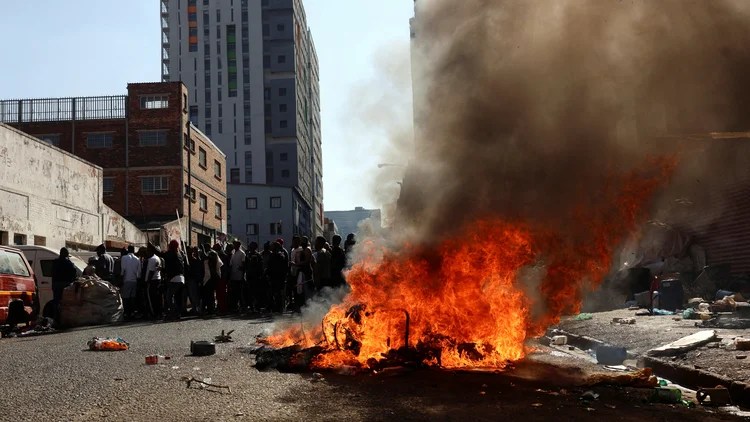
In a scathing attack, Dr Mbuyiseni Ndlozi MP (South African politician, radio host and political activist) argued that ‘The hypocrisy of Nigeria and Ghana must be called out’. Ndlozi was critical of Abuja and Accra’s public responses to xenophobic attacks against their citizens in South Africa. The two countries are among other African countries whose citizens were either killed or sought emergency repatriation in fear of fellow black Africans in South Africa when vigilante groups like the March and March set a deadline of June 30th, 2026, for immigrants to leave SA. Ndlozi’s pacifist speech tried to be everything to everyone, condemn locals he called opportunistic activists, condemn Nigeria and Ghana for being ‘un-African’ and protect SA’s global image. Did he manage the balance right?
Ndlozi who feels the response by Nigeria and Ghana is hyperbolic accused the two countries of hypocrisy, arguing that their ‘loud public outcries’ over immigration tensions in South Africa are “un-African” and align with a foreign agenda to isolate SA on the international stage. In a rather patronising tone, he showed very little empathy for human loss and distress suffered by citizens from the two countries in the xenophobic attacks.
In his speech, Ndlozi concentrated on sound bites to an already sold audience – giggles and smiles noticed among the attendees as Ndlozi parroted his bias; he minimised the issue and only offered superficial justification for his strong accusations against the two countries while making some mocking remarks in his mother tongue during his speech.
Perhaps Africa must start taking human rights abuses seriously. What is un-African about protesting human rights abuses? What decorum should be followed when raising human rights abuses and who dictates that? The nature of responses from Zambia (which he conveniently described as a small country), Malawi, Lesotho, Mozambique is informed by the countries’ specific context and must not be seen as tone setting on how African States should respond to injustices committed against their citizens in another African state.
Did it occur to Ndlozi – whose speech conveniently excluded Zimbabwe – that genuine emotional hurt had occurred and was behind the manner of the described responses and that he maybe emotionally disconnected hence minimising the impact of the abuses?
When suggesting the responses of Nigeria and Ghana ‘are consummate with very reactionary forces in the West and Middle East’ whose objective is to make South Africa a pariah state on the international stage, did it occur to him that Africans do have agency and autonomy outside the West and do not need instruction from foreign forces on how to feel and respond to abuse?
Understandably, Ndlozi’s interest is his South African base and protecting the image of SA is his priority. He does not comprehend other countries’ frustrations over SA’s foreign policy inconsistencies. To other African states, South Africa displays a sharp double standard by championing pan-African unity and international solidarity abroad while failing to stop violent anti-migrant campaigns that have forced many African nationals to flee the country.
But objectivity is required to build a better Africa. Xenophobia is neither unique to SA nor a new issue in the continent. While South Africa is the current focal point, hostility toward foreign nationals is a recurring challenge across various parts of the continent:
- 1969: Ghana introduced the Aliens Compliance Order, deporting hundreds of thousands of foreign workers.
- 1972: An entire immigrant Asian population was expelled by Uganda’s Idi Amin.
- 1983: Expulsion of over two million undocumented West African immigrants by Nigeria.
- South Africa: Previous deadly riots erupted in 2008 (killing over 60 people) as well as recurring spikes in 2015 and 2019.
As we can see from history, no one is without blame and there is a case for arguing Nigeria and Ghana may have over-reacted in their response to the latest immigrant attacks in SA. Arguably, a behind the doors diplomatic strategy would have been more effective in identifying and dealing with the structural causes of the unequal development and disproportionate migration patterns across the continent.
It must be emphasised that the xenophobic attacks in SA are not state sanctioned as were some historical cases in the continent. President Cyril Ramaphosa has called the treatment of foreign nationals in the country deeply shameful and warned that South Africa cannot preach African integration while practicing exclusion at home.
Ndlozi may have a point about Nigeria and Ghana over-reacting over the xenophobic attacks but to dismiss, off hand, their frustration over the abuses pivots towards insensitivity and ignorance, is vile and unconstructive as is his allegation that the two countries are not Pan-African but working in tandem with the West and Middle East to isolate SA on the international stage without providing proof. We must identify and deal with Africa’s poor human rights record, structural causes of economic stagnation and collapse. Good quality information is required to avoid anti-migrant rhetoric setting the migration policy.


Share your valued views below.