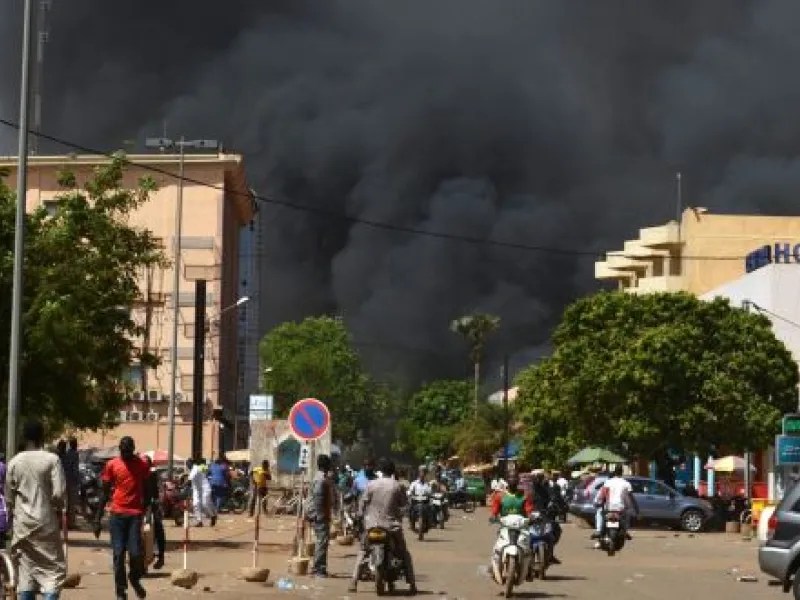
Explaining the decision to oust Lieutenant-Colonel Paul-Henri Sandaogo Damiba (head of the military-led Patriotic Movement for Safeguard and Restoration (MPSR) that replaced the Government) from power on 30 September 2022, Capt. Ibrahim Traoré gave the same reason as his predecessor who had led an overthrow of the democratically elected President Roch Marc Christian Kaboré in 24 January 2022 – the failure to address the jihadist insurgency. In a written statement, Traoré said that, faced with a deteriorating situation, they had tried to persuade Damiba to refocus the transition on the security question. The statement stated that “Damiba’s actions gradually convinced us that his ambitions were diverting away from what we set out to do. We decided this day to remove Damiba.”
Background
Structural vulnerabilities, weak government institutions and widespread corruption within the army have reduced the government’s ability to provide effective security for its citizens. Following the 2014 ousting of President Blaise Compaoré, Burkina Faso lost its stabilising role in the regional crisis; thus, allowing jihadist violence to spread from neighbouring Mali into Burkina Faso.
Burkina Faso has faced a severe security crisis linked to the jihadist insurgency since 2015; by 2025, non-state armed groups like the Al-Qaeda-linked Jama’at Nusrat al-Islam wal-Muslimin (Group for the Support of Islam and Muslims, JNIM) and Islamic State controlled an estimated 40% of the territory, limiting humanitarian access and isolating some 800,000 people in besieged towns. The escalating violence is responsible for a major humanitarian crisis – over 2 million people internally displaced and thousands of fatalities annually.
Assessing current security situation
Security conditions in Burkina Faso have worsened significantly since Capt. Ibrahim Traoré took control of the government in a 2022 coup. Compared to the three preceding years, Jihadists have killed an estimated 87% more civilians. And estimates suggest annual deaths of 2,000 civilians from Islamists attacks. During the same period, government-aligned forces are reported to have killed up to 132%. JNIM and Islamic State now operate openly in as much as 80% of the country.
All actors, the Burkinabè forces and their auxiliaries – the Volontaires for the Défense de la Patrie (Volunteers for the Defense of the Homeland, VDPs) and the JNIM and Islamic State, have been implicated in serious crimes against humanity.
Dealing with security challenges
Capt. Ibrahim Traoré’s main objective on taking control of government was to halt and reverse security deterioration caused by the jihadist insurgency and stabilise security provision in Burkina Faso.
Addressing security challenges facing Burkina Faso needs an open-minded, all-inclusive approach. Military might alone will not address the decade long, and counting, conflict. Reasonable adjustments, listening to understand causes from all perspectives, building consensus and working on long-term solutions with all concerned parties must be the priority of every leader. If the junta can deliberate on national security provision with Russians, what stops them from engaging JNIM and Islamic State?
Cracking down on dissent
Instead of dealing with the message, the military junta has opted on clamping down on the messenger; they are tightening their grip on the ‘reality’ the public can see, hear, and know. Various strategies are employed to crack down on dissent, suspending independent media outlets, enforced disappearances of journalists, dismantling civil society groups, hindering political pluralism, and punishing critics, among them medics and magistrates, by sending them to the frontlines of the war against the jihadists.
On May 2026, Burkina Faso’s media regulator ordered the suspension of French broadcaster TV5Monde accusing the broadcaster of “disinformation” and “apology of terrorism” in its reporting on jihadist activity in Burkina Faso and neighbouring Mali, reasons given for two previous suspensions in 2024.
Controlling the narrative
Under Traore, “Burkina Faso has become a propaganda machine,” (Alioune Tine, Afrikajom Center). In suppressing the private media and opposing voices, the junta has created a communication vacuum allowing it free rein over public discourse. Government friendly groups such as the Rapid Communication Intervention Battalions are saturating social media platforms with well-coordinated messaging (including AI videos) that promotes a cult of personality around President Ibrahim Traoré, discredit critics, attack perceived enemies, and seek to discredit human rights organizations. These groups allegedly spread hate and violence and inflame ethnic tensions through widespread anti-Fulani rhetoric that places blanket blame for Islamist armed groups’ activities on the Fulani community thereby inciting hostility against the population.
Conclusion
Improving security was Traoré’s goal, but that seems to be slipping away with jihadists escalating insecurity to civilians while making territorial gains. Although Capt. Traoré has dismissed accounts of a deterioration of security as “fake” or “manipulation” and junta authorities repeatedly reject allegations of Burkinabè forces and VDPs committing serious crimes, human rights groups have documented cases of crimes by all parties. On the pretext of improving security, the junta has suppressed fundamental rights and freedoms, including through arbitrary arrest, enforced disappearance, and unlawful conscription of political opponents, dissidents, human rights activists, journalists, and judicial personnel.
FURTHER READING
Burkina Faso’s Junta Escalates Attack on Information | Human Rights Watch
Burkina Faso: Crimes Against Humanity by All Sides | Human Rights Watch
A Growing Divergence of Security Narratives in Burkina Faso – Africa Center


Share your valued views below.