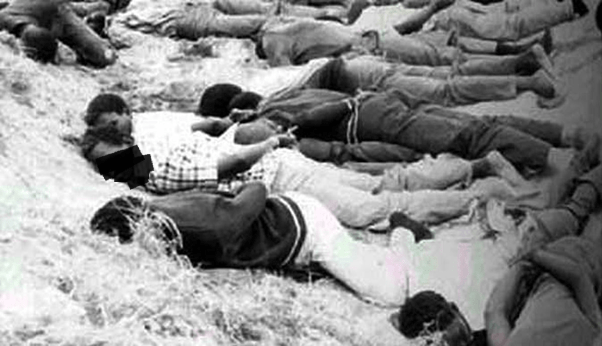
Coldblooded killers took control. Dark clouds covered the sky over Matabeleland, day turned to night. Everyone, including the law, fell silent as the supremacist ethnic Shona government of Prime Minister Robert Mugabe deployed a specialist military unit, the Fifth Brigade, to execute unarmed civilians in Matabeleland between January 1983 and April 1984. The evil operation was named ‘Gukurahundi’. For belonging in a different tribe, Ndebele people were stripped of their dignity, stripped of their liberty, stripped of their freedoms and all human rights including the right to life. Communities were physically and mentally tortured; people deprived of food, women raped, unborn babies ripped out of their mothers’ wombs and crushed to death, people forced to watch their loved ones killed in cold blood and some buried alive in mass graves.
a Genocide before the world
In intent, scale and impact the Gukurahundi operation was a crime against humanity; it had markings of a genocidal act against Ndebele people, and not [as described in 1999 by its chief architect Robert Mugabe] ‘a moment of madness’. Contrary to that contemptuous claim, Gukurahundi was a deliberate, hate-fuelled political process executed by tribal Shona supremacists with misplaced objectives to establish a utopia beyond politics – one people, one land, one truth and eliminate difference.
ZANU’s dream to reality
From its formation in 1963, ZANU’s goals were tribal leaning; the party’s goals were tribal in nature, protecting ethnic Shona interests, promoting Shona supremacy and marginalising Ndebele people from power.
Unlike PF ZAPU that was national in both agenda and form, ZANU’s political base was Mashonaland and ethnic Shona people. To the ZANU elite, Ndebele people were a swamp that needed to be drained. The party was unambiguous about its intent to annihilate Ndebele people and turn Shona creed into law in an independent Zimbabwe. To date, the party’s palpable unease with or hostility to multi-ethnicity, multicultural society and political plurality remains its central feature.
What is Gukurahundi?
Robert Mugabe, the architect and enabler of this darker world operation named it Gukurahundi – Shona noun for “the rain that washes away the chaff (from the last harvest), before the spring rains”. Gukurahundi was in all intent a genocidal act, it was a deliberate attempt at exterminating Ndebele people and had nothing to do with the provision of safety and security in the country through the containment of some alleged dissenting armed ex-ZIPRA combatants and/ or armed criminals who went on a spree of committing crime, including killing white farmers in Matabeleland.
Gukurahundi Past vs Gukurahundi History
There is no argument about the Gukurahundi past, it happened but the Gukurahundi history is highly contentious. Gukurahundi past is an ocean of brutal, evil and inhuman events that once happened in Matabeleland and parts of Midlands between 1983 and 1984 with government approval. These past events have been reconstructed by ZANU PF on the basis of its present experience and political interests – this is the Gukurahundi history as we know it today.
We highlight the inevitable selectivity of the reconstruction of elements from the Gukurahundi past since the infinite detail and totality of that past would never be wholly reconstructed. Like any history writing process, the writing of the Gukurahundi history was a process of highly selective reconstruction of features of the past through the lenses of ZANU PF leadership and its sympathisers in the academia.
why telling the Gukurahundi horror story matters
Disconnecting us from our past is an essential and ongoing political project of the ZANU PF-led government carefully carried out via the formal history education in schools and colleges. Without a knowledge of the past a population soon loses it’s sense of identity leaving it vulnerable to manipulation.
The ZANU 1979 Grand Plan clearly had an understanding that the most effective way to destroy people is to deny and obliterate their own understanding of their past hence the history being taught our children in the independent Zimbabwe. The education package is targeted at erasing the memories of that period. The history being taught tacitly minimises the Gukurahundi atrocities while exaggerating the value of the Unity Agreement of 1987.
Ensuring Gukurahundi is never minimised must be central to our discourse and any groups and individuals whose operational approach to the atrocities is the contemptuous ‘let bygones be bygones’ must review their human conscience; ignorance is the biggest roadblock to action on genocide and other crimes against humanity.
As the atrocities got out of control, a blanket of silence spread across the country and the World; nobody acknowledged them, at least in public. Mashonaland and ethnic Shona people did not only fail to condemn the inhuman actions of an ethnic Shona dominated government, but condoned and even celebrated the killings of Ndebele people.
To this day many ordinary people from Mashonaland profess ignorance of the atrocities while those aware perpetuated the ZANU PF narrative that the state operated within its constitutional remit of protecting citizens from harm, thus, it was conducting a legitimate security operation against armed malcontents or dissidents and justified despite all the available evidence to the contrary.
Taking control of the narrative
We are not telling the Gukurahundi story and calling for the remembrance of the victims from a victimhood mentality. We want to reclaim control of the narrative, capture and reflect true emotions generated by the inhumane ZANU actions for a responsive healing space to be created; we cannot delegate that role to others, certainly not our aggressors; ZANU will never fully comprehend the emotional impact of its actions upon its victims, let alone acknowledge them. The principal objective of telling the story of the Matabeleland killings and repeating those stories is to ensure it remains alive in our politics for generations to come so that the same is not repeated.
The victorious always write the history, and no surprise the current Gukurahundi history reflects the past through ZANU PF lenses. Soon after the 1987 Unity Accord, the ZANU PF party utilised its control of the government to recreate the past and depict it in academic history books – books that glorified ZANLA forces and ZANU while totally ignoring ZPRA and PF ZAPU.
Quite simply, the Gukurahundi history narrated in academic books turns out to be a fable agreed upon in the ZANU PF headquarters and approved by an ethnic Shona dominated government; the history notoriously favours and exonerates ZANU PF and its sympathisers.
Gukurahundi accountability
Calling Gukurahundi brutality ‘a moment of madness’ – as did President Mugabe – is insensitive minimisation of a crime against humanity; deliberate murders of civilians for their identity must not be turned into an undiagnosed psychiatric disorder; the World needs accountability from the people behind the planning and execution of the atrocities. The Matabeleland public know the extent of the atrocities but it is still waiting to understand the trigger and to know all the accessories in the crime.
The story of Gukurahundi must be told by locals and the truth of that past told from the Matabeleland victim’s experience to correct the misrepresentation of the past as told in history books written by ZANU PF and its sympathisers in the academia. We are duty bound to ensure the facts of the Gukurahundi atrocities are coherently delivered, understood and acknowledged; we must be on hand to always be exposing the warning signs for what led up to it so that it is never repeated in this and the next generations.
The depth of State involvement in Gukurahundi crimes
Although no one in authority at the time has claimed responsibility for the atrocities, available evidence suggests Gukurahundi was planned at the highest level of government and formed Zimbabwean government policy. On 7 March 1983 Roland ‘Tiny’ Rowland, a British businessman and chief executive of the Lonrho conglomerate with heavy economic commitments in Zimbabwe, met with Mugabe and then subsequently reported to the American ambassador in Harare that he was “absolutely convinced” that Mugabe knew about the atrocities, and claimed that Mnangagwa, then secretary of state for security, was “fully aware”. Tiny described Mugabe as “blunt and unyielding”.
Conceiving the 5th Brigade
There is no doubt the 5th Brigade was a preconceived idea of then Prime Minister Robert Mugabe. In October 1980, Mugabe signed an agreement with the North Korean President, Kim II Sung for the Korean government to train a brigade for the Zimbabwean army. This agreement was signed soon after Mugabe had announced the need for a militia to “combat malcontents”. It is important to note that there were no security disturbances at the time.
It is widely believed that North Koreans arrived in August 1981 to train the new brigade whose purpose Mugabe pointed was to “deal with dissidents and any other trouble in the country”; it would be interesting to know what he meant by “…any other trouble in the country”. It must be noted that at the time there had been very little internal unrest that warranted the intervention of a specialist armed force.
Rightly uncomfortable and suspicious of Mugabe’s ulterior motives, Joshua Nkomo, leader of PF ZAPU who was concerned the 5th Brigade would be used by Mugabe to suppress opposition and build a one-party state queried the necessity of this exclusive brigade arguing the country already had appropriate and adequate security provision to handle internal problems. Mugabe’s direct response was a retort warning that dissidents should “watch out”.
The 5th Brigade was mainly drawn from ex-ZANLA troops with a few ZIPRA troops drawn into the unit; the latter were withdrawn before the end of the training. There are unproven allegations of the presence of some foreigners in the unit. The training of the 5th Brigade lasted until September 1982, when Minister Sidney Sekeramayi announced training was complete. The first Commander of 5th Brigade was Colonel Perence Shiri.
With its distinguishing red berets, the 5th Brigade was an exceptional unit in that it was not integrated into the national army and was answerable only to the Prime Minister (Mugabe), and not to the normal army command structures. Their codes, uniforms, radios and equipment were allegedly not compatible with other army units.
The Gukurahundi brutality
Over a nine-month period the 5th Brigade killed, tortured and raped tens of thousands of unarmed civilians. Estimates put the figure of unarmed civilians who died as a direct result of the operation to at least 20 000 mostly Ndebele people; many more suffered severe physical and/ or psychological harm, and more continue to suffer the brunt of that illegal mission in various forms.
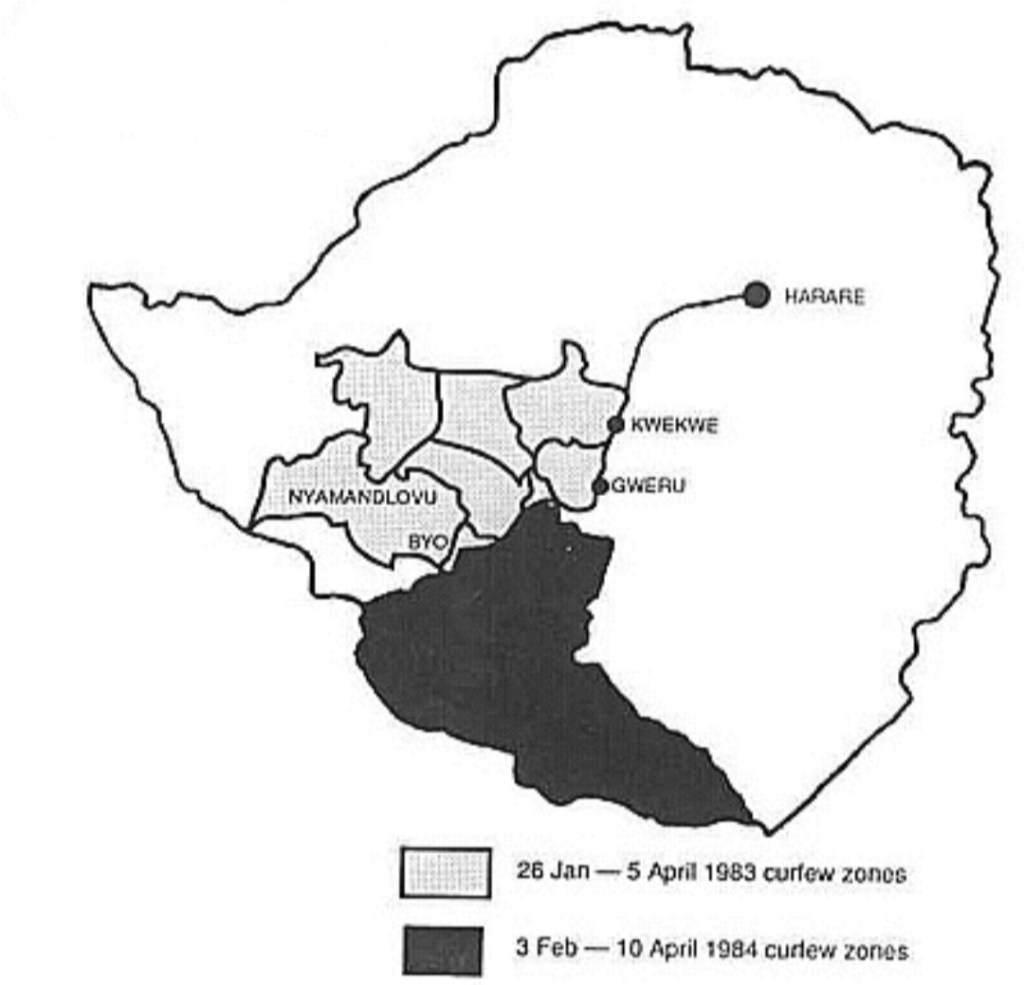
The first phase of the Gukurahundi atrocities took place in Matabeleland North (26 January – 4 April 1983), see Fig. 2, when state security forces enforced a curfew, and massacred, beat, mass raped, and tortured hundreds of thousands of civilians. Looting and burning of villages defined the operation that left entire communities emotionally, economically and physically devastated.
Bolstered by the accomplishment of the first phase, the unperturbed bloodthirsty Mugabe regime moved on to its second phase; this was marked by the launch of a strict curfew in parts of Matabeleland South (3 February – 10 April 1984) – Fig. 2. An exclusion zone was created in the communal areas within which the Central Intelligence Organisation (CIO), the Zimbabwean National Army (ZNA), and Fifth Brigade enforced a policy of food deprivation against the overwhelmingly Ndebele population; it is estimated that at least 350 000 Ndebele civilians were affected in the operation.
British government wilful blindness to Gukurahundi massacres
The Gukurahundi genocide was undoubtedly a creation of the Mugabe government, but through a catalogue of misjudgements and inaction the British government was complicit; the British could not use their economic and political influence in Zimbabwe to help halt the massacres. British government authorities swallowed every word from Mugabe without questioning; quite literally, his views formed British evidence and informed its attitude and approach to the situation.
The established communication of British officials in London and Harare gives strong indication that the British government was aware of the Gukurahundi atrocities but consistently minimised their scale to preserve British relations with the Mugabe regime. Even at the height of the Gukurahundi atrocities, the British government’s authorities favoured a sympathetic and constructive advice strategy, rather than strong criticism of the Zimbabwean government.
Concluding a review of the thousands of documents obtained under the Freedom of Information Act, Dr Hazel Cameron – a lecturer in international relations at the University of St Andrews in Scotland – argues that the British government adopted a ‘wilful blindness’ policy to preserve its relations with Robert Mugabe and protect British economic and political interests in Zimbabwe.
Even nauseating is the racialised British moral assessment and judgement of the Gukurahundi atrocities; British officials were less concerned with the gruesome Zimbabwean state actions but clearly preoccupied with the security of white community with one diplomat quoted as saying, “…the white farming community (a substantial portion of which is British or dual [nationality]) are being treated scrupulously correctly by the Fifth Brigade and, while they dislike the methods being used, are relieved that their own security has improved very considerably as a result of Fifth Brigade deployment”.
The apparent conflict of interest meant that the protection of black human lives in Matabeleland and parts of Midlands was secondary to the British agenda leading to US diplomats raising concerns that the British Foreign Office prioritised bilateral relations with Zimbabwe over human lives in Matabeleland; the US diplomats argued that British officials were excessively defensive about the Mugabe-orchestrated atrocities in Matabeleland and even intimated that some Foreign Office officials acted like Mugabe apologists.
- UK downplayed killings in Zimbabwe to guard its interests, study claims
- British policy towards Zimbabwe during Matabeleland massacre: licence to kill
Conclusion
The illegal killing of tens of thousands of innocent civilians by the Zimbabwean regime using the Fifth Brigade forces in Matabeleland was a grave breach of international humanitarian law. It is unacceptable that instead of strong condemnation, the world adopted silence in response to those illegal killings where unarmed civilians were targeted and killed for their identity. The truth about the atrocities must be uncovered and the Zimbabwean government must be held accountable for crimes against humanity. If Gukurahundi is not adequately addressed in this generation, it shall raise its ugly head again in the next generation, we just do not know who the victims would be.
 MTHWAKAZI LAB
You must be logged in to post a comment.