Kenya policing abyss: police brutalising the public they should be protecting. Sounds familiar? Unfortunately, police brutality reverberates across Africa. The continent is a dystopian reality of weaponized governance where civil institutions meant to serve the public are turned against the same citizens. Weaponization of police has become the norm not an exception. Violent policing techniques have become part of a wider conversation of public safety.
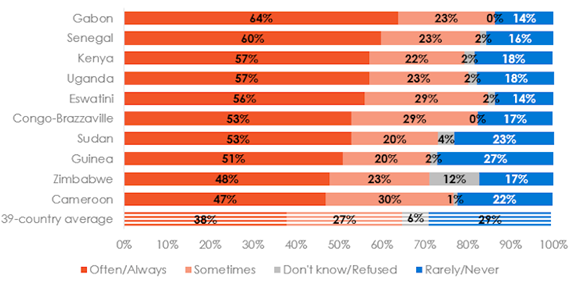
A recent study suggests low public regard for the quality of policing and trust in law enforcement agents is low. A survey of 39 countries in Africa between 2021 and 2023 indicates that perceptions of police misconduct, corruption and brutality are widespread (Afrobarometer, 2024).

4 in 10 civilians say their police “often” or “always” use excessive force in managing protests (38%) and dealing with suspected criminals (42%) (Afrobarometer, 2024).
Evoking colonial history to explain why Black governments lack empathy for their people is not a sustainable argument. Yes, the colonial state founded contemporary governance institutions, informed distribution of power including the disproportionate use of force to enforce compliance, but was that not the system natives fought to replace?
This is the right time for African authorities to be fully accountable to their people. And the public must finally accept that their own Black leaders, not former colonial rulers, are accountable for their suffering.
Of course, it is hard to believe that the people you look to for safety and security will be the same people who are causing you so much harm. But this is our reality; the public is scared and hurting, and people are dying in the hands of police supposedly conducting their ‘duties’.
Gradually, there has been a normalisation of State violence in postcolonial Africa where law enforcement agents seek to establish order by brute force and building consensus is the least of their interest. The idea of policing by consent seems like an operational inconvenience for officers trained to show strength through force and without emphasis on empathy driven interventions. Police officers serve governing party interests over the Constitution.
Infinite abuse of civilians by African governments is a betrayal of the objectives of the liberation struggle. Governments have weaponized the police; there is increasing militarization of police forces and widespread use of military-style equipment and tactics in domestic law enforcement. Police are routinely equipped with military-grade weapons and vehicles, trained in military tactics, and military personnel are sometimes used in domestic law enforcement operations.
From Gabon, Kenya, Uganda, Eswatini, Senegal or Zimbabwe, one thing stands out when it comes to police management of protests – violence against the public. Video after video of often peaceful protesters being attacked with tear gas, batons, water cannons, rubber and live bullets form our lived reality. The question is how do people stand for this? How many people must die before we rise and say ‘enough is enough?
Violence fatigue is a great risk. Which is the reason I cannot bring myself to watch yet another video of police brutality, not because I do not care, but because we are all a few videos away from becoming completely desensitized. The public execution of citizens exercising their right to protest will never be normal.
It is unacceptable that in contemporary Africa dissent would translate to death, and people would lose lives for exercising their right to peaceful protest. On 20th June 2025 demonstrations against a finance bill that was going to raise new taxes in Kenya triggered police officers to switch from using water cannon and tear gas to firing live bullets. But at what point was such a move deemed proportionate and justified?
Decision-makers must take accountability and hold those under their authority to high standards. For policing to regain public respect, accountability for police officers must become an expectation, not an aberration.
Police violence against the public has no place in a civil society. It not only compromises public safety but makes policing difficult for good officers. When you have police officers who routinely abuse citizens, you erode public confidence in law enforcement.
When individuals encounter the police, they often know what they have done wrong and await the penalty, or, in cases, they wonder what they did wrong and await an explanation. Whichever scenario, the expectation is for such encounters to be civil; people do not expect to be manhandled or abused by officers. No one should be traumatized by the fear that the officers might kill them. Yet the African reality is that police brutality has become normalised; fear of officers is confused for respect of law.
Police violence against communities they should be protecting erodes public trust in the police to maintain order. When the public loses confidence in the police, a vital resource of information police need for their duties is lost. Use of brute force does not make our countries any safer.
 MTHWAKAZI LAB
Share your valued views below.