As the global leader, it is in America’s economic, political, and security interest for the Trump administration to stop its misguided foreign aid policy of malign neglect. Freezing foreign aid and shuttering the United States Agency for International Development (USAID) does not reflect leadership but neglect. It threatens global instability and harms US global interests, integrity and increases insecurity. It is in the interest of the US and the rest of humanity to help tackle poverty, hunger among other grievances in Africa, Latin America, parts of Asia and to help vulnerable countries improve their economies.
USAID was established on 3 November 1961 to manage the US’ foreign aid programmes; when it was created, it brought together several existing foreign assistance organisations and programmes.
“There is no escaping our obligations: our moral obligations as a wise leader and good neighbour in the interdependent community of free nations – our economic obligations as the wealthiest people in a world of largely poor people, as a nation no longer dependent upon the loans from abroad that once helped us develop our own economy – and our political obligations as the single largest counter to the adversaries of freedom.”
– John F. Kennedy
Today the US government is the single-largest aid donor in the world, accounting for more than 40% of all humanitarian aid the UN tracked in 2024. But other countries do give a fair share of their own. There is a broad international commitment for wealthy countries to provide 0.7% of GNP to assist poor countries annually. Norway, Sweden, Luxembourg, Denmark, and the UK exceed that benchmark. The average contribution for all wealthy nations is around 0.4% annually. The US ranks near the bottom at below 0.2%.
Freezing foreign aid and shuttering USAID under the auspices of making savings is misguided, incompetent, uncaring, and dangerous; it is based on a false notion that the US is being taken advantage of by others and gives away too much money and other resources to individual countries and regions for nothing in return.
Foreign aid spending is a small but contentious part of US federal budget. Since fiscal 2001, US foreign aid disbursement as a share of total federal expenses has ranged between 0.7% and 1.4% of total federal outlays; this is a fish in the pond for what the US gets in return.
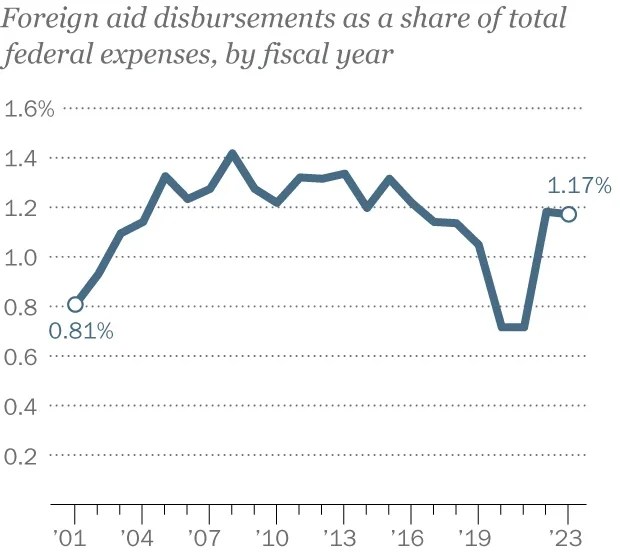
Giving to the poor does not need to hurt the US, it is morally right and reflects the US moral standing in the world. Also, when the US Assists others, not only them benefit, but so does the US too. Foreign aid helps lay the groundwork for mutually beneficial trading relationships; 11 of America’s top 15 trading partners were once recipients of US foreign aid.
Assistance is provided to support security, economic and political development of recipient countries and people. Significantly, that assistance also advances one or more of the following overriding US interests:
- Contributing to US national security by supporting allies in promoting regional and global stability and peace
- Reflecting the core US value of caring for others in need — providing humanitarian assistance to victims of war, violence, famine, and natural disasters
- Advancing US and recipient economic interests by building economies and markets. For instance, in Tennessee, over $33 billion in goods and services was exported to foreign markets in 2014, and trade supports more than 22 percent of jobs – that is 830,000 local jobs. USAID spends about $2 billion purchasing food from American farmers for their humanitarian food aid programmes, like Food for Peace.
Clearly, the engagement is not a one-way street; the US benefits significantly from providing foreign aid. By advancing US security and prosperity, foreign aid promotes national security through helping to combat fertile conditions for terrorism to thrive – poverty, weak institutions and corruption – by extending US leverage, promoting economic development, good governance and transparency.
It can be argued that the more the Washington administration insulates itself from vulnerable countries and regions across the world, the more it curtails its leverage and increases its vulnerabilities.
The flaw in the MAGA rhetoric lies in its narrow worldview that the US does not need the world, and the world cannot survive without the US; the reality is different, the US needs the world as much as the world needs the US.
As the largest debtor in the world – the largest debtor the world has ever seen at any time in human history, the US needs the world.
Todd (2003) in Grapin (2004) describes how the United States moved from self-reliance at the beginning of the 20th century to current economic dependence, unwillingly becoming a “predator” in the global system. Todd (2003) points out that in 2000 the US siphoned off 19 percent for stocks and 30 percent for bonds from the rest of the world. Furthermore, 10% of America’s industrial consumption depends on imported goods for which there is no corresponding balance in national exports.
We conclude that far from being a costly misadventure, foreign aid is a proactive, cost-effective intervention. Compared to legacy security tools like economic sanctions and military might, foreign aid costs less and the US gains allies and leverage rather than creating enemies.
 MTHWAKAZI LAB
You must be logged in to post a comment.