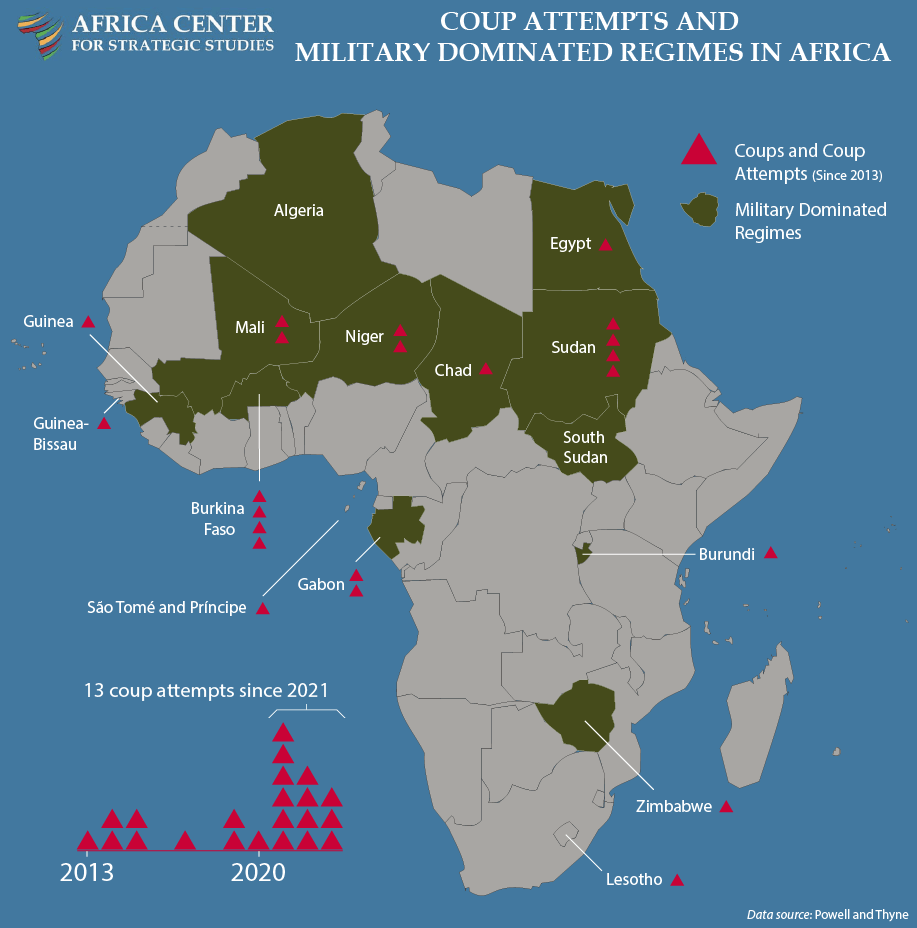
The dominance of military regimes is both a cause and result of crises of governance linked with significant systemic and institutional fragility in Africa. According to Matthias Basedau (2023), the trend of military dominance is being driven by acute political crises, traditionally politicised militaries and self-reinforcing regional dynamics. In 1972, military autocracies accounted for 24.6 per cent of the world’s countries, almost half of those (45.7 percent) were in Africa. By 2014, global military regimes had dropped down to 7 percent with almost 50 per cent of them in Africa. In the latest slew of coups, there have been at least 10 coups attempts in Central and West Africa between August 2020 and 2024.
Below is a table showing different types of military governments and their descriptions. A number of countries in Africa have been in and out of one kind or the other of these military regimes; see the map below for the spread of coup attempts and military dominated governments in Africa.
| Type of military government | Description |
|---|---|
| Military occupation | An occupying power administers an occupied territory, exercising executive, legislative, and judicial authority |
| Military dictatorship | The military exerts total control of a country, usually after overthrowing the previous rulers in a coup |
| Martial law | The military temporarily governs the civil population without the authority of written law |
| Military junta | A government led by a committee of military leaders |
| Stratocracy | A government traditionally or constitutionally run by a military |
| Military democracy | A war-based society that practices democracy, with an elected and removable general as supreme chief |
Apportioning blame to colonialism for governance crises in Africa has, quite understandably, become a go to explanation, but also, we need the African society to take a fair share of responsibility if we are to address the apparent militarisation of governments in the continent.
Let us make no bones about the form of the colonial state in Africa; the colonial state was not invited but imposed upon Africans; no African was consulted for their views on whether they wanted to be colonised or not. The colonial state had to aggressively impose its authority on native societies; it had to be a brutal military state that acted with impunity in all aspects of life. Brutal force was used to ensure compliance to the dictates of the colonial political and economic institutions.
The colonial state was established for the benefit of European colonisers and any observed improvement of local areas and to the natives was incidental. The extractive colonial institutions concentrated power and resources in the hands of a small ruling class or elite while disenfranchising natives. Arguably this broke any potential social cohesion between the ruling class and the unwilling subordinates.
We must acknowledge the fact that the legacy of colonialism in Africa is a major cause of poverty in the continent today. The impact of the extractive colonial economy was the weakening of institutions and spatial inequities; these extractive economic institutions aggravated local sustainable economic growth but helped Europeans transfer resources out of the colony.
Recognition of the impact of extractive colonial institutions must not be misused to minimise internal responsibility for many negative socio-political and economic outcomes; we call for local accountability and emphasise the need for a re-set of internal social and political moral standards. African society must demand more of itself; we must raise questions because we want to find answers to them not just because in the questions we find socio-political capital, and the questions themselves must not end up becoming a valuable entity that builds socio-political capital for certain groups while drawing attention away from an array of local causes of conflict.
When African countries gained independence from their European colonisers, they did not institute tangible institutional paths. But what happened in many countries was the adoption and cosmetic adaptations of the colonial state by the black elite backed by the military.
The military wings of most liberation movements outmanoeuvred civilian leaders and took control and power of the movements at independence, and there a catastrophe emerged. Instead of protecting nations from external enemies, the military set about trying to shape and manage society. We argue that military dictatorships tend to lack institutional infrastructure for maintaining social control and elite cohesion. And where there is divergence of views, their go to resource is the military apparatuses that promotes aggression against unfavourable protests.
Civil society must rise and reclaim fundamental institutions from the military and its political surrogates. We must raise moral standards and wage a moral and political war against military dominance of governance institutions in the continent.
Military regimes must not be our future but the past to learn from. The goals and priorities of military regimes are to strengthen the military apparatuses, maintain order, even if it means using disproportionate force to suppress legitimate protests, and strengthening civilian structures and institutions is not often viewed as a priority.

