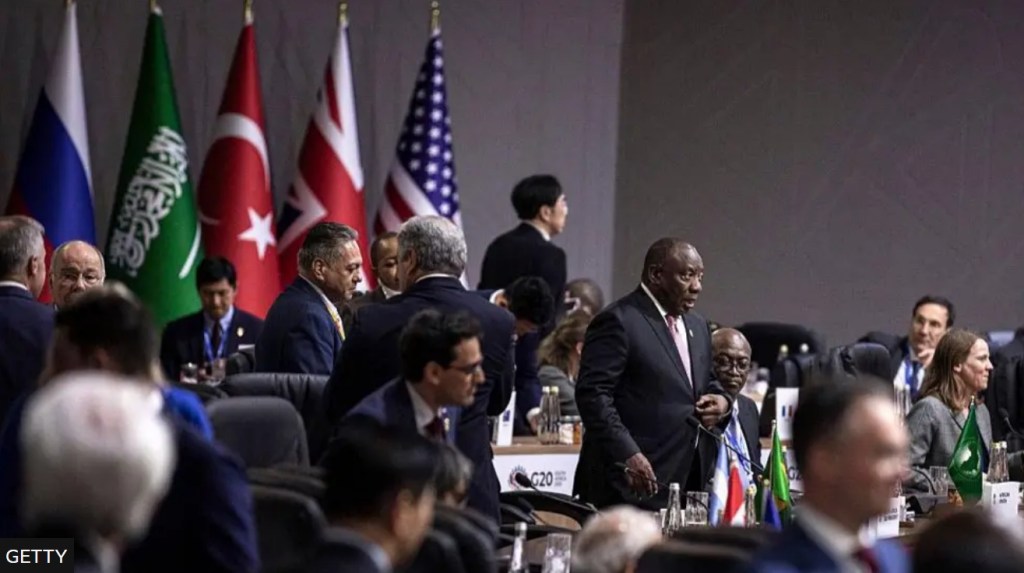
G-20 summit in South Africa was the twentieth and first held in Africa and the first to be boycotted by a major member. The USA President Trump chose to stay away as promised after fomenting lies of a systemic white population wipe-out by the South African administration. Facts do not lie, while violent crime is a challenge for South Africa’s government, it is a problem that affects the country, not sections of it. The causes are multi-layered, but race is not a factor.
U.S. non-participation in the latest G-20 meeting of 2025 held in SA is in line with Trump’s longstanding “America First” policy – an intentional withdrawal from multilateralism in favour of unilateralism. Trump has been outspoken about America’s shifting allegiances and interests; the U.S. under the Trump regime is transactional, it has been withdrawing from its traditional allies in the West, including from its trusted neighbours Canada and Mexico. There is a view among the MAGA grassroots that the USA has been exploited by everyone, and Trump’s regime is intent on addressing the perceived ‘unfair’ transactions.
Work commenced the very first day of Trump’s regime; the “America First” agenda has overseen cuts in foreign aid, withdrawals from international agreements, and a less engaged role in global institutions, thus creating a void for rivals like China to fill. The shift has also coincided with a relative decline in the U.S. economic share of the global GDP, which, combined with other actions, has decreased American soft power and created a more multipolar world order with shifting alliances.
It is important that Africa does not find itself left behind in the shifting centre of gravity in global politics. We must first strengthen internal governance institutions to promote transparency. Local power re-distribution is vital to re-engage communities long left behind and now lacking motivation in local institutions. We need to make sure institutions are founded on local interests and not mere capitulation to foreign demands.
Ownership of our policies is essential so we can adjust and adapt to public needs, and we are able to project appropriate and timely responsiveness to increasingly fluid global dynamics. Strengthening political, economic and social relations within the African continent is only possible through enhanced economic and political cooperation. Sharing of critical intelligence must be prioritised and that requires improvement of security and the lifting of unnecessary travel restrictions of the population and withholding of critical data essential for planning.
What the U.S. aid withdrawal from Africa has taught us is that we had an unhealthy relationship with aid; we were over-reliant on it, but we can survive without the U.S. A strong and organised Africa is what we require to start forming relationships from a position of strength not as beggars of foreign aid but as equal business partners presenting valuable products to the table.
Reconfiguration of local systems to empower the average citizen is critical for a genuinely independent Africa. We must no longer rely on Western solutions but invest in our own. Instead of trying to force fit Western solutions into African problems, we need African solutions to African problems. An informed population will be essential in the reconstruction of African systems that must be truly African in form and relevant in their local application.
Funding research programmes and promoting independent local media is fundamental to development. We need to build an informed constituency to promote local and continent-wide accountability, provide constructive critique of the leadership, and equally important is good research to promote informed interventions in both the short and long term. The land issue is historically sensitive and critical in the African continent’s progress, but it must be approached more objectively and less subjectively if society is to benefit.
Injustice in land ownership and use is behind perpetual armed conflict. Conflict between different interest groups has been the hallmark of the continent as have been spiralling military takeovers of civilian institutions. Marginalisation of certain population groups is the major source of many unresolved conflicts within the continent; these must be addressed, not suppressed. Before we blame the West, let us objectively listen to dissenting local voices, confront our fears and work to resolve identified issues. Consolidation of power in certain population groups leaving others powerless, vulnerable and resentful is harmful to coherence and development.
The U.S. has the right to choose its allies, so does Africa. When we strengthen African institutions – social, economic and political, and enhance intracontinental engagement, we will be in a strong position to choose friends we need, associates we want and reject toxic partners. We need a change in mindset from a continent convinced it needs saving by others from catastrophic droughts, wars and economic collapse to one that actively contributes and engages in well-funded research programmes, honest and equal partnerships with the West and the East on programmes of mutual interest.
 MTHWAKAZI LAB
Share your valued views below.